Every March, millions of fans try their luck at predicting the NCAA tournament bracket. And every March, most of those brackets collapse by the second round. Upsets, buzzer-beaters, and one-off flukes make March Madness one of the hardest events to forecast in sports. But now, artificial intelligence is stepping in—not just to guess, but to calculate.
Over the past few years, March Madness AI predictions have become a serious part of the conversation. Instead of relying on gut feeling or historical hunches, some fans and analysts are turning to algorithms. But does AI really have what it takes to outsmart the madness?
How AI Models Build NCAA Bracket Predictions?
AI doesn't watch games or listen to locker-room talk. It looks at data—and a lot of it. Most bracket models that utilize artificial intelligence are trained on decades of tournament data, including seed histories, offensive and defensive ratings, player statistics, injury reports, win margins, pace of play, and even referee tendencies. The AI doesn't just process this information—it learns from it. That's where machine learning comes in.
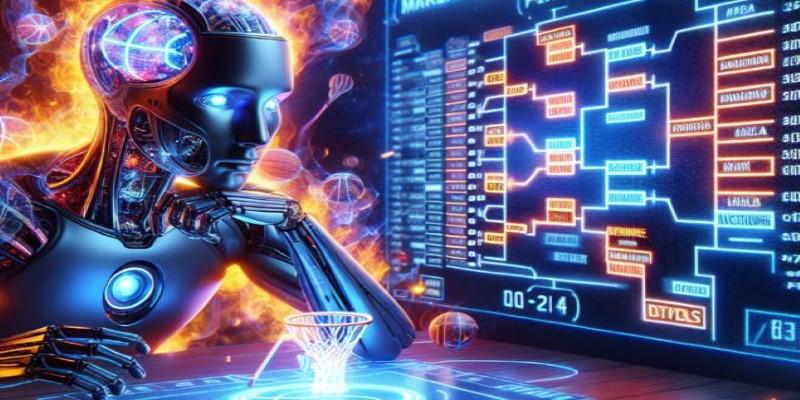
The most effective models typically use supervised learning techniques, where the AI is fed historical tournament outcomes and associated data, learning what variables tend to predict wins. Once trained, the model is then given current season data to predict matchups. Logistic regression and gradient boosting are often used, but deep learning has started to make an appearance in more advanced systems, especially those that try to pick up on non-linear relationships, like how teams perform after long travel or back-to-back games.
Some models even integrate real-time updates. As conference championships wrap up and Selection Sunday sets the field, these AI systems immediately adjust their calculations based on current injuries, team momentum, and unexpected seeding choices. A few tools combine this with simulated outcomes—running each matchup thousands of times to estimate probabilities, not just yes-or-no picks.
What AI Gets Right—and Where It Still Falls Short?
One advantage of March Madness AI predictions is consistency. Unlike human bracket pickers swayed by emotion or bias, AI views matchups objectively. That’s why some models are known for smart upsets or ignoring hype. In recent tournaments, AI-powered brackets flagged double-digit seed wins that fans overlooked. It doesn’t fall for name recognition or coaching legends—it sticks to numbers.
Another strength is adaptability. Human experts may cling to old assumptions, like every No. 1 seed reaching the Final Four. AI learns from evolving patterns, like the rise of mid-majors or how three-point shooting changes gameplay. Some systems even factor in styles of play—such as zone defense versus fast-break offense—and weigh those matchups historically.
Still, the madness of March doesn’t always follow logic. That’s where AI struggles. No model accounts for a star spraining an ankle mid-game or a senior catching fire in his last tournament. AI doesn’t sense emotions and struggles with chaos. It may predict a season well, but the single-elimination format is too random. Even top models rarely top 70% accuracy.
The quality of input data also limits potential. Not all college basketball stats are equal. Some mid-major conferences have poor tracking or inconsistent records, which can skew results. Coaching decisions—like surprise lineup changes or new schemes—are hard to quantify. AI can only work with the data it gets.
How Fans Are Using AI Tools to Shape Their Brackets?
AI-generated bracket tools have exploded in popularity. Casual fans can now plug into online models that simulate the tournament thousands of times and generate suggestions for each round. These platforms don’t just say who’s likely to win—they provide win probabilities, upset alerts, and risk-reward analysis based on seeding and public consensus.

Some fans use AI as a tie-breaker, letting it guide close calls between evenly matched teams. Others rely on it for sleeper picks, trusting the data to uncover overlooked threats. A few even go all-in, submitting AI-generated brackets into workplace pools and ESPN's tournament challenge. Interestingly, hybrid strategies are becoming increasingly common, combining a data-driven core with personal tweaks, such as supporting a favorite alma mater or following a hot team during conference play.
More serious participants and analysts take it further, building AI into their broader strategies. Sports markets have started to reflect the influence of AI predictions, with lines sometimes shifting when popular tools favor an underdog. Some professionals have developed their own AI systems, trained to spot opportunities where public expectations may be off and to identify strong picks against the spread.
AI isn't replacing the tradition of bracket-picking, but it's reshaping how some people approach it. The experience becomes less about hunches and more about probability. That doesn't mean it's more fun for everyone, but for those who enjoy strategy, March Madness AI predictions have added a whole new layer of competition.
What the Future Looks Like for AI and NCAA Predictions?
As AI evolves, its role in NCAA bracket forecasting will grow. With player tracking and enhanced in-game analytics, the input data for AI models is getting richer. Tools like computer vision now capture player positioning, shooting form, and movement in real time. This could push predictive modeling beyond box scores and efficiency ratings.
NCAA tournament simulations may become more dynamic, reacting not just to static inputs but to live game events and player trends. Some AI tools might even factor in psychological metrics or stress indicators, though those remain experimental.
Another shift is accessibility. As more platforms integrate AI into bracket challenges, the gap between casual and competitive pickers may narrow. If everyone has the same models, the edge may shift to how well someone interprets the output or when they go against it.
Still, randomness will always have a seat at the March Madness table. Even if AI nears perfection at forecasting, the tournament’s unpredictability remains part of its charm. After all, if a machine picked the perfect bracket, what fun would that be?
Conclusion
AI is helping shape the way people think about NCAA brackets. It can spot patterns humans miss, stay objective under pressure, and update instantly based on changing data. But March Madness thrives on chaos, and no model—no matter how advanced—can fully tame that. March Madness AI predictions are getting sharper each year, but they're not crystal balls. That uncertainty is why people continue to watch, keep guessing, and return. The math helps, but the madness still wins.